
SIMPLAAFY: A potential next chapter in post-WATCHMAN care
Both reduced-dose NOAC and aspirin monotherapy were non-inferior to DAPT
(Vs. DAPT Control Arm; p-value<0.0001)1
DAPT (Control)
Reduced-dose NOAC
Aspirin
Primary composite endpoint at 6 months*
Death, stroke, systemic embolism, or major bleeding
SIMPLAAFY
studied two less aggressive monotherapy regimens for post-implant treatment after WATCHMAN FLX Pro
1,857
patients randomized 1:1:1
CHA2DS2-VASc: 4.2±1.3
HAS-BLED: 2.7±1.1
Key Clinical Outcomes
| DAPT (Control) | VS | Reduced-dose NOAC | Aspirin | |
|---|---|---|---|---|
| Ischemic stroke (6-month rate) | 0.7% | 0.7% | 0.7% | |
| Major bleeding (6-month rate) | 4.5% | 2.7% | 1.7% | |
| 45-day DRT | 3.4% | 0.9% | 2.7% |
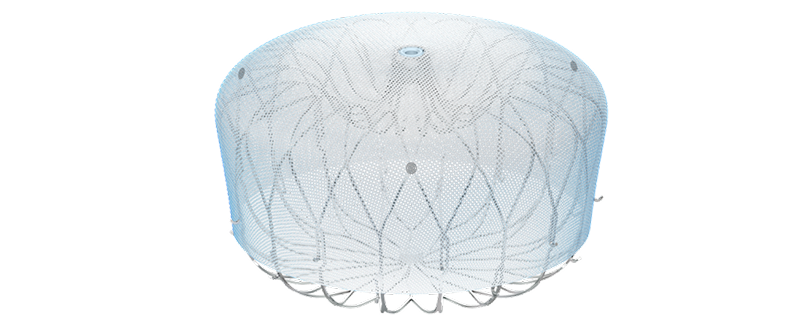
The technology behind the trial:
WATCHMAN FLX Pro
Featuring HEMOCOAT™ Technology
Designed to promote faster, more controlled healing2



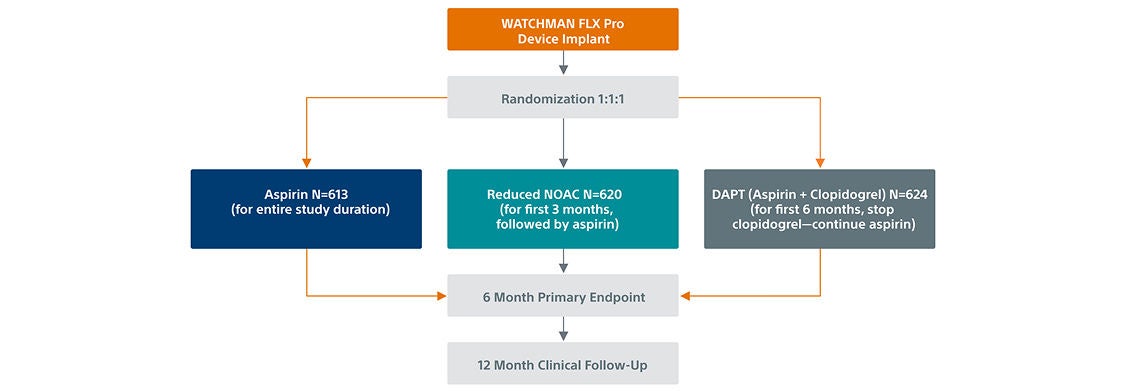
SIMPLAAFY Trial Design
The SIMPLAAFY clinical trial evaluated two less aggressive monotherapies as alternative drug regimens compared to dual antiplatelet therapy (DAPT) following LAA closure with the WATCHMAN FLX Pro LAAC Device in patients with non-valvular AF.
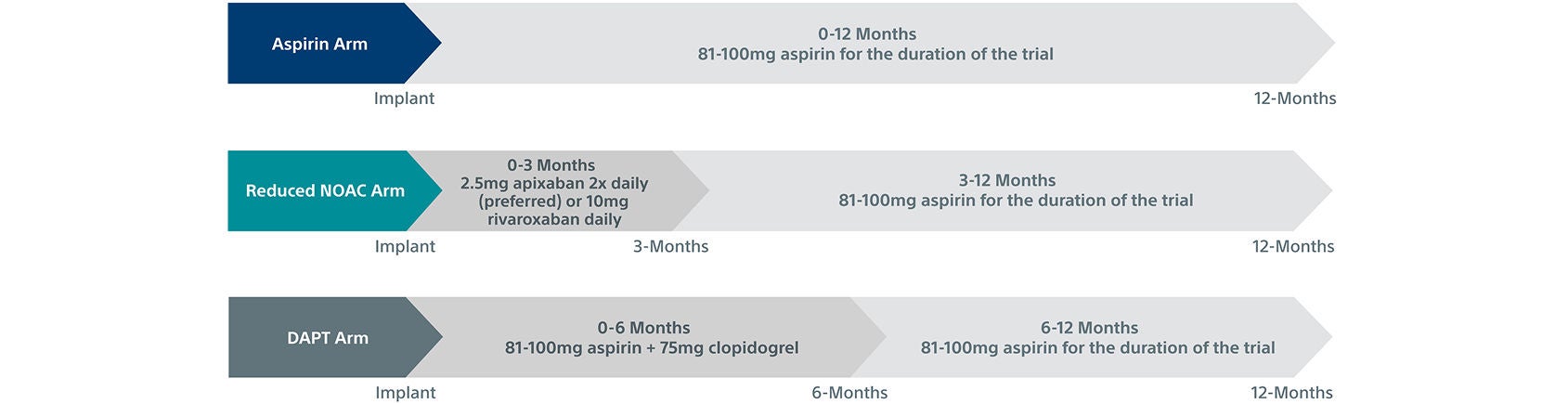
Trial arms: post-implant regimens
Explore the evidence
| Patient characteristics | DAPT N=624 | Reduced-dose NOAC N=620 | Aspirin N=613 |
|---|---|---|---|
| Age, mean (SD), years | 76.3 (7.4) | 76.1 (7.7) | 76.0 (7.7) |
| Female sex | 257 (41.2) | 270 (43.5) | 270 (44.0) |
| CHA2DS2-VASc, mean (SD) | 4.2 (1.3) | 4.2 (1.3) | 4.2 (1.2) |
| HAS-BLED, mean (SD) | 2.7 (1.1) | 2.6 (1.1) | 2.6 (1.1) |
| Congestive heart failure | 196 (31.4) | 212 (34.2) | 195 (31.8) |
| Vascular disease | 282 (45.9) | 277 (45.2) | 286 (47.0) |
| Diabetes | 188 (30.1) | 183 (29.5) | 171 (27.9) |
| Hypertension | 561 (89.9) | 552 (89.0) | 539 (87.9) |
| Abnormal renal function | 101 (16.2) | 104 (16.8) | 97 (15.8) |
| Prior stroke or TIA | 136 (21.8) | 133 (21.5) | 115 (18.8) |
| Prior major bleeding | 130 (20.8) | 134 (21.6) | 125 (20.4) |
Patient characteristics were well balanced. There were no significant differences between arms
| 45-day imaging outcomes | DAPT | Reduced-dose NOAC | Aspirin |
|---|---|---|---|
| Peri-device Leak | |||
| Complete seal (Leak = 0 mm) | 439 (78.4) | 432 (78.8) | 436 (78.7) |
| >0-3 mm | 80 (14.3) | 83 (15.1) | 87 (15.7) |
| >3-5 mm | 31 (5.5) | 26 (4.7) | 24 (4.3) |
| >5 mm | 4 (0.7) | 1 (0.2) | 1 (0.2) |
| Device-related thrombus | |||
| DRT (Grade 2 or 3 echodensity/HAT)a | 20 (3.4) | 5 (0.9) | 16 (2.7) |
| Detected and treated by site | 16 (2.7) | 1 (0.2) | 10 (1.7) |
| 6-month outcomes | DAPT | Reduced-doseNOAC | NOAC vs. DAPTRelative Risk[95% confidence interval] | Aspirin | Aspirin vs. DAPTRelative Risk[95% confidence interval] |
|---|---|---|---|---|---|
| Primary composite (Death, stroke, systemic embolism, or major bleeding)* | 41 (6.9) | 31 (5.1) | 0.75 [0.48, 1.18] | 20 (3.3) | 0.49 [0.29, 0.82] |
| Death | 13 (2.2) | 13 (2.2) | 0.99 [0.46, 2.11] | 8 (1.3) | 0.61 [0.26, 1.47] |
| Cardiovascular | 3 (0.5) | 5 (0.8) | 1.65 [0.40, 6.86] | 3 (0.5) | 1.00 [0.20, 4.92] |
| Non-cardiovascular | 6 (1.0) | 6 (1.0) | 0.99 [0.32, 3.05] | 3 (0.5) | 0.50 [0.13, 1.98] |
| Unknown | 4 (0.7) | 2 (0.3) | 0.49 [0.09, 2.69] | 2 (0.3) | 0.50 [0.09, 2.71] |
| Stroke | 6 (1.0) | 4 (0.7) | 0.66 [0.19, 2.32] | 4 (0.7) | 0.66 [0.19, 2.34] |
| Ischemic | 4 (0.7) | 4 (0.7) | 0.99 [0.25, 3.93] | 4 (0.7) | 1.00 [0.25, 3.97] |
| Hemorrhagic | 2 (0.3) | 0 (0.0) | – | 0 (0.0) | – |
| Systemic embolism | 0 (0.0) | 0 (0.0) | – | 0 (0.0) | – |
| All ISTH Bleeding | 76 (12.8) | 44 (7.3) | 0.57 [0.40, 0.81] | 33 (5.5) | 0.43 [0.29, 0.64] |
| Major bleeding | 27 (4.5) | 16 (2.7) | 0.59 [0.32, 1.08] | 10 (1.7) | 0.37 [0.18, 0.76] |
| Clinically relevant non-major bleeding | 52 (8.7) | 29 (4.8) | 0.55 [0.36, 0.86] | 23 (3.8) | 0.44 [0.27, 0.71] |
CEC-adjudicated. Binary event rates. Number of subjects included is based on subjects with sufficient follow-up and/or subjects who experienced an event.
ISTH (International Society on Thrombosis and Haemostasis).
Learn more about the WATCHMAN FLX™ Pro LAAC Device
WATCHMAN FLX Pro is an FDA approved device. The use of off-label post-implant drug regimens with the WATCHMAN FLX Pro device in AF patients is considered investigational.
* DAPT served as the control arm. Reduced dose NOAC and Aspirin arms were not statistically compared.
References
1. Kar S, et al. Antithrombotic Monotherapy After Left Atrial Appendage Occlusion: Primary Results of the SIMPLAAFY Randomized Trial. Late-breaking clinical trial, TCT 2026.
2. Saliba WI, et al. Enhanced Thromboresistance and Endothelialization of a Novel Fluoropolymer-Coated Left Atrial Appendage Closure Device. JACC EP 2023. (Results from a preclinical model)
3. Wagner et al., Biomaterials Science: An Introduction to Materials in Medicine, 4th Edition, 2020.
4. Boston Scientific Data on File.